
DUBHACKS · PRODUCT DESIGN · 2025—2026
From a 3-hour Excel line to a DubCoin system
A two-part case study: a hacker profile that shipped in 2025, and a data-informed redesign for 2026.
spent on prize redemption in 2024—more than 8% of the 36-hour hackathon
staff members editing the same Excel sheet at once
of 2025 hackers added a bio, LinkedIn, or GitHub
hackers redeemed at least one prize in 2025
Overview
DubHacks rewards hackers with coins. Spending them used to take hours.
DubCoins are DubHacks’ currency. Hackers earn them by attending workshops and activities, then redeem them for prizes at the end of the weekend.
I designed the experience in two rounds. Version 1 (2025) shipped, giving us real usage data. Version 2 (2026) is designed but not yet built with backend support; and it's based on what we observed during the event.
Jump to Final Solution ▼Context
Redemption was the biggest pain point of 2024.
Redemption was scheduled for one hour on Sunday. It took about three. Five to seven tired staff shared one Excel sheet to look up hackers, check IDs, update balances, and track inventory.
Lines got long, and some prizes ran out before people reached the table.
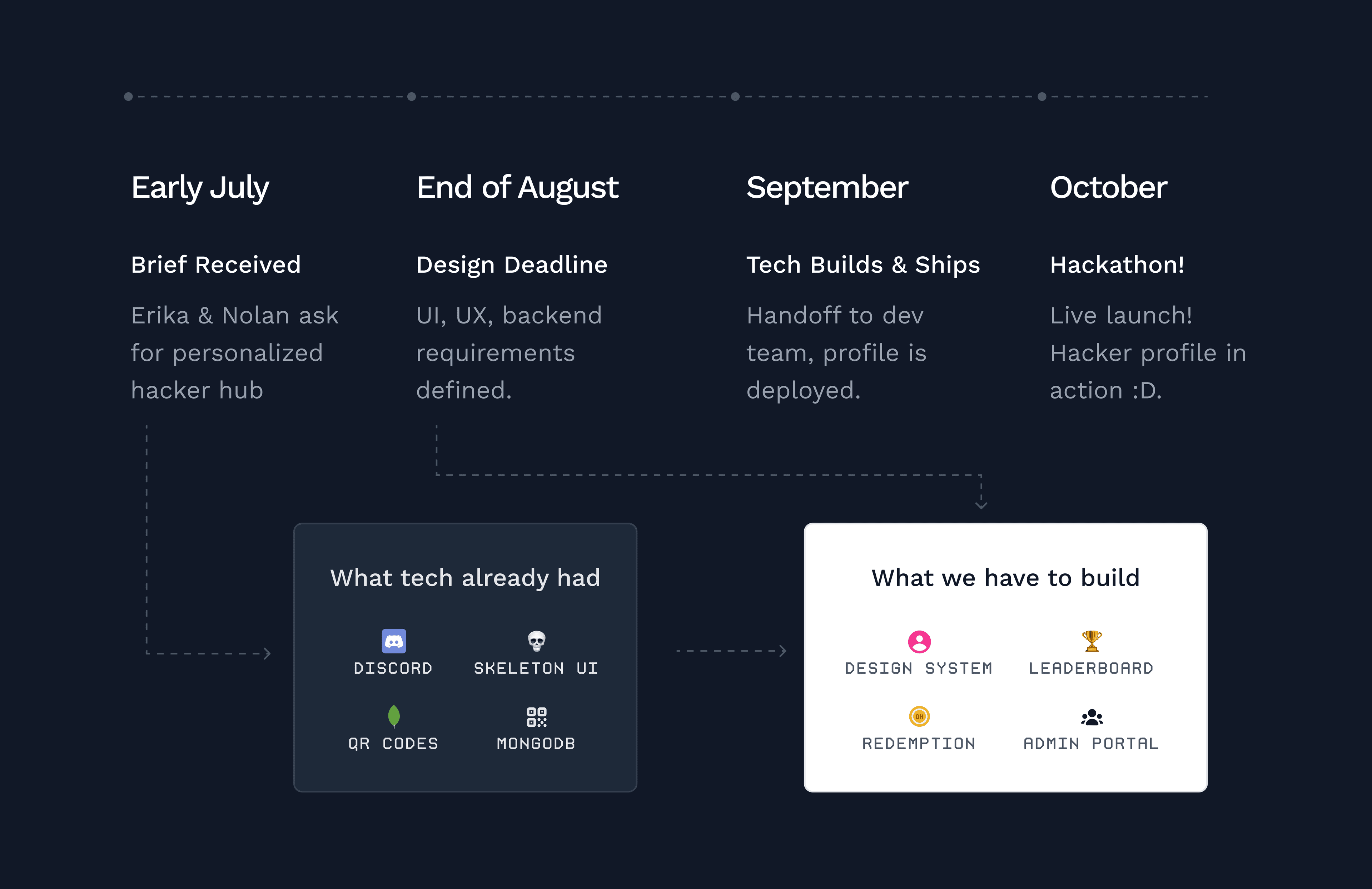
The brief came in early July, with design due at the end of August. Tech had a skeleton UI, workshop QR codes, and a database. Design defined the experience and what the backend needed.
The brief
Build a personalized hacker hub that centralizes information, cuts day-of questions, and shows each hacker a clear view of their experience.
Insights
Staff were acting as the database.
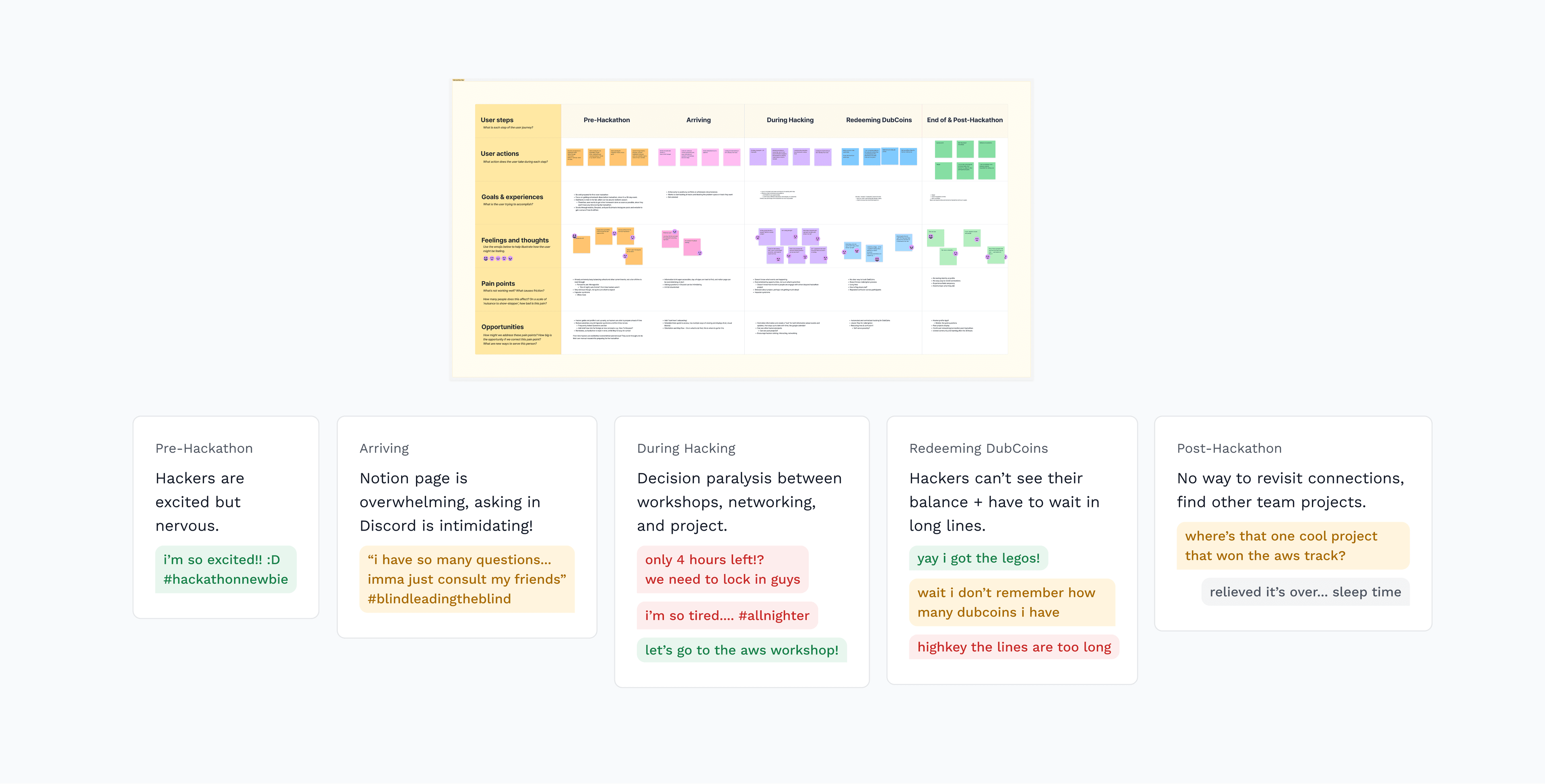
We mapped the 2024 flow with context from co-directors Erika and Nolan, and design advisor Meiyao. Three issues stood out:
Every transaction needed someone to edit a spreadsheet by hand.
Hackers couldn’t see their own balance. “How many DubCoins do I have?”
Staff had to match a person’s balance to available prizes from memory.
The system pushed memory and coordination onto people. The profile could make information visible, while redemption needed a flow staff could run quickly and reliably.
Version 1 · 2025
Our first bet: a hacker profile, and QR codes for redemption.
Choosing a redemption model
We considered a self-serve pick-up flow and staff-led QR redemption. The pick-up model could update inventory immediately and reveal prizes only when a hacker had enough coins. But it introduced operational complexity and a risk of 1,000+ people hitting a system the tech team could not yet scale with confidence.
We shipped QR redemption instead. Each hacker had a personal QR code; staff scanned it at the prize table, checked the redemption history, and marked items claimed. Staff were a resource we already had, and the pattern reused workshop QR codes.

The profile included bio, skills, and interests; a Connect directory; a DubCoins page; and a Home screen with a schedule and countdown. Before development, we used a Lovable prototype to help tech and directors react to the direction.
The 2025 design was collaborative: Annie built the staff side, Medha led most screens and the design system, and I worked on Home logic, countdown, and navigation.
What we learned
The hackathon taught us what the prototype couldn’t.
After launch, I asked the tech lead for the usage data and compared our assumptions with how hackers actually used the profile.
- QR was slower than typing. Camera focus, lighting, and Wi-Fi introduced an estimated 4–7 seconds per scan.
- Most hackers skipped the social profile. About 17% filled in a bio, LinkedIn, or GitHub.
- Hackers mostly used laptops. Phones came out most often at the prize table.
So the next version would lead with useful event information and DubCoins, and let staff search by a username instead of scanning a code.
Final Solution · 2026 redesign
Same problem, simpler bet: hackers show a code or username; staff scan or search.
The redesigned dashboard is planned for user testing during the 2026 hackathon. Here are the decisions that carry the research forward.
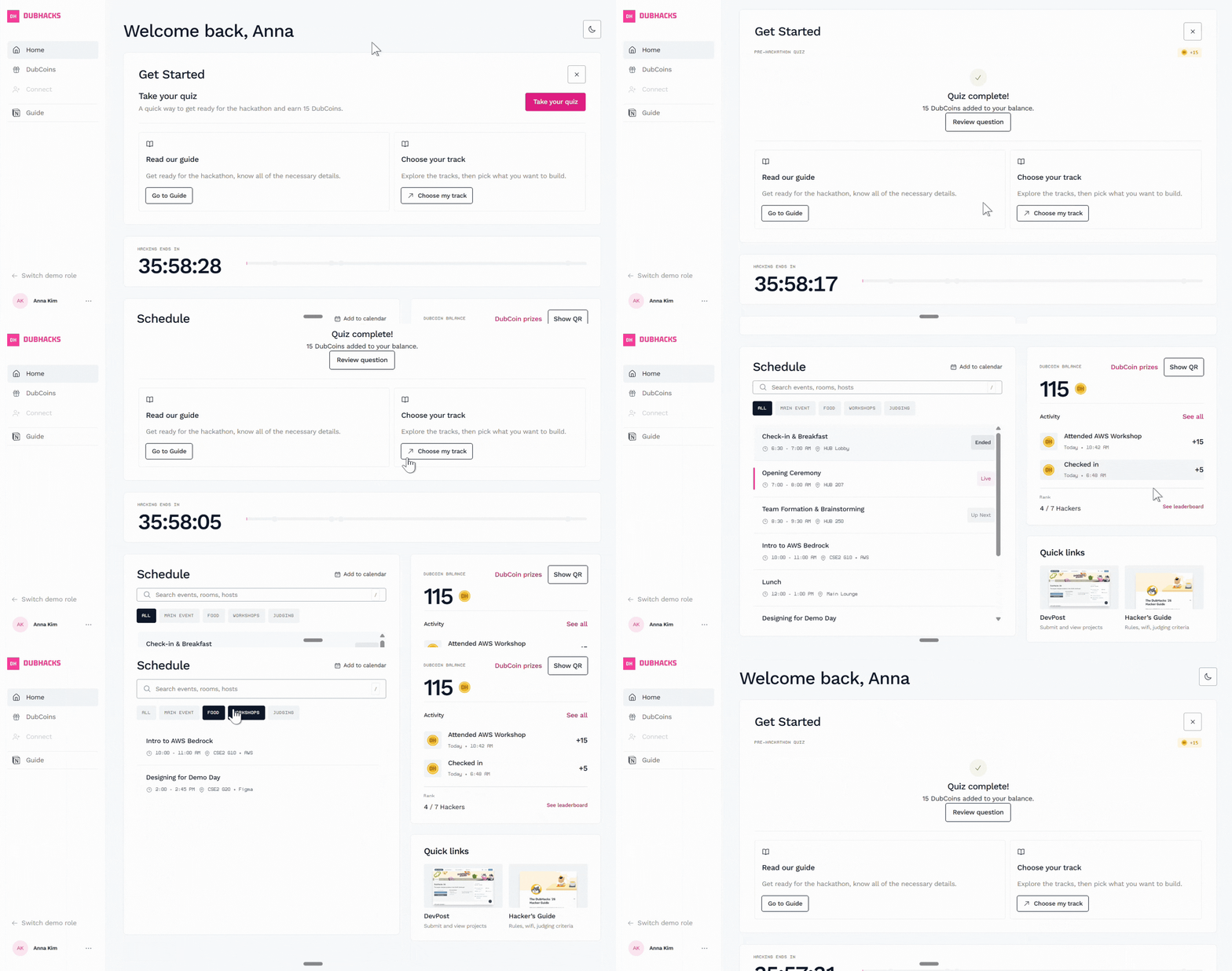
Home is about information, not identity.
A live countdown, event schedule, DubCoin balance, and links to DevPost and the guide bring the day’s essentials forward. Before the event, Get Started guides hackers through the setup steps.
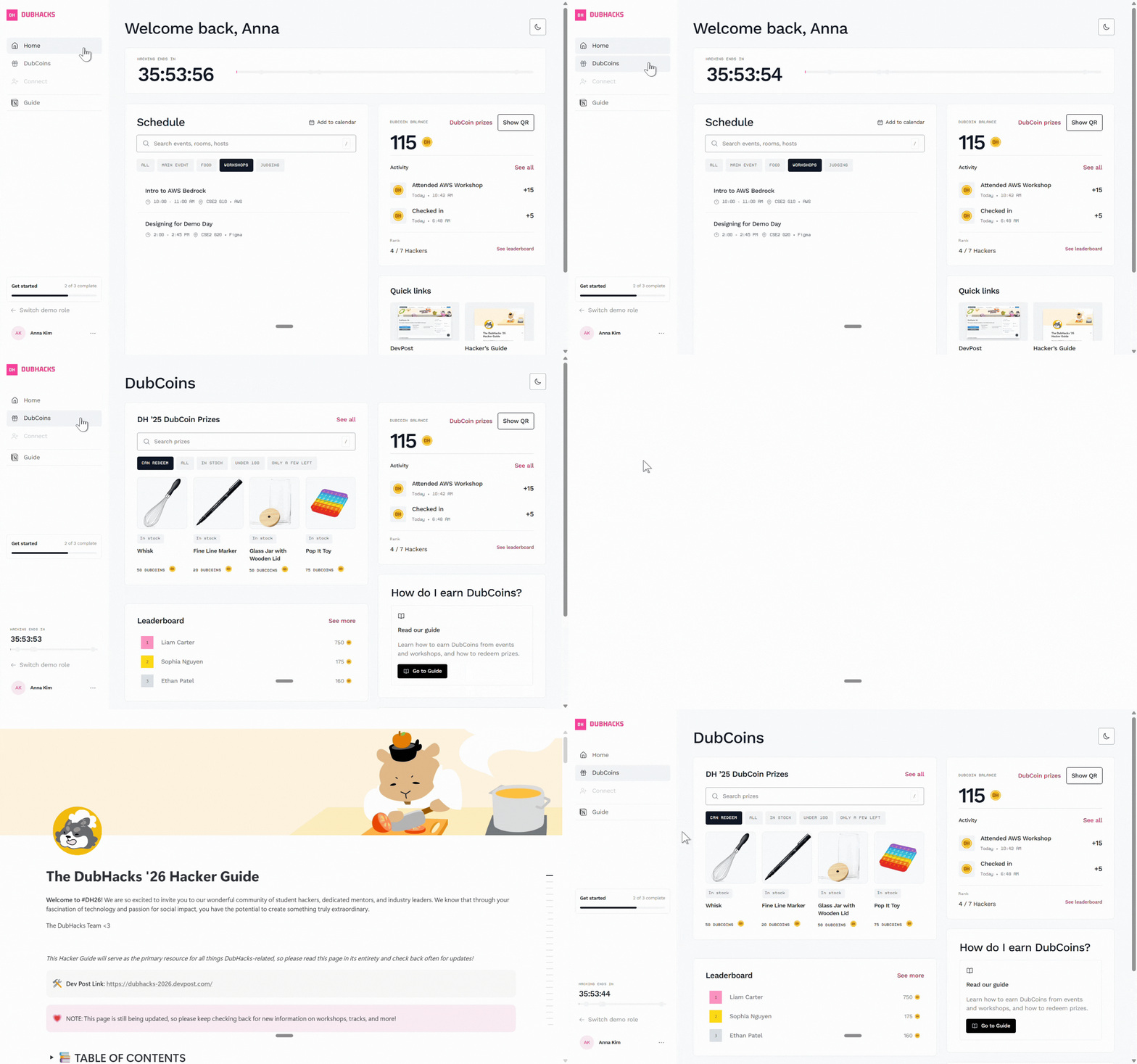
A sidebar makes the hub feel like a tool.
The top navigation became a left sidebar, a familiar pattern for a dashboard. Connect remains available for hackers who want to browse profiles or find teammates.
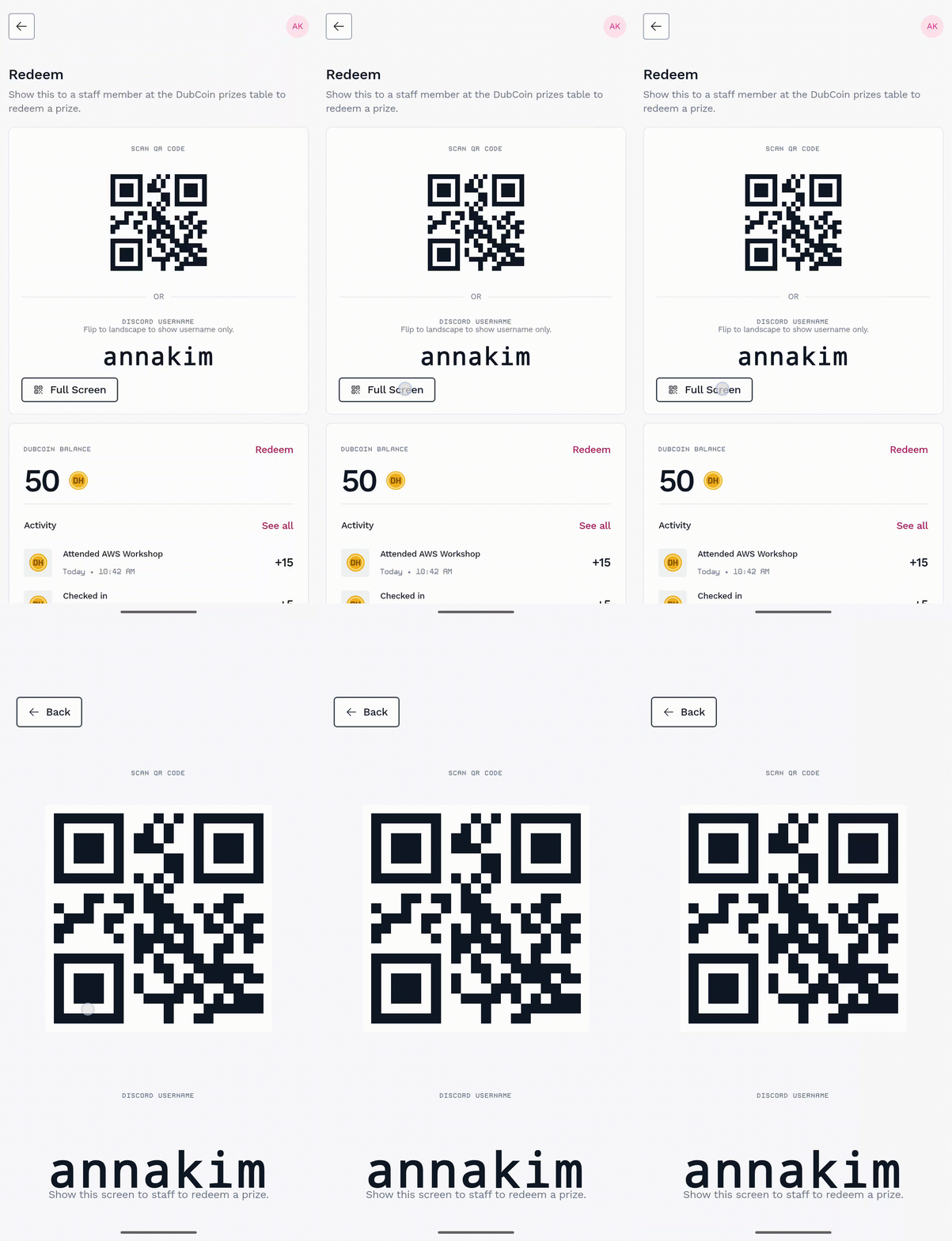
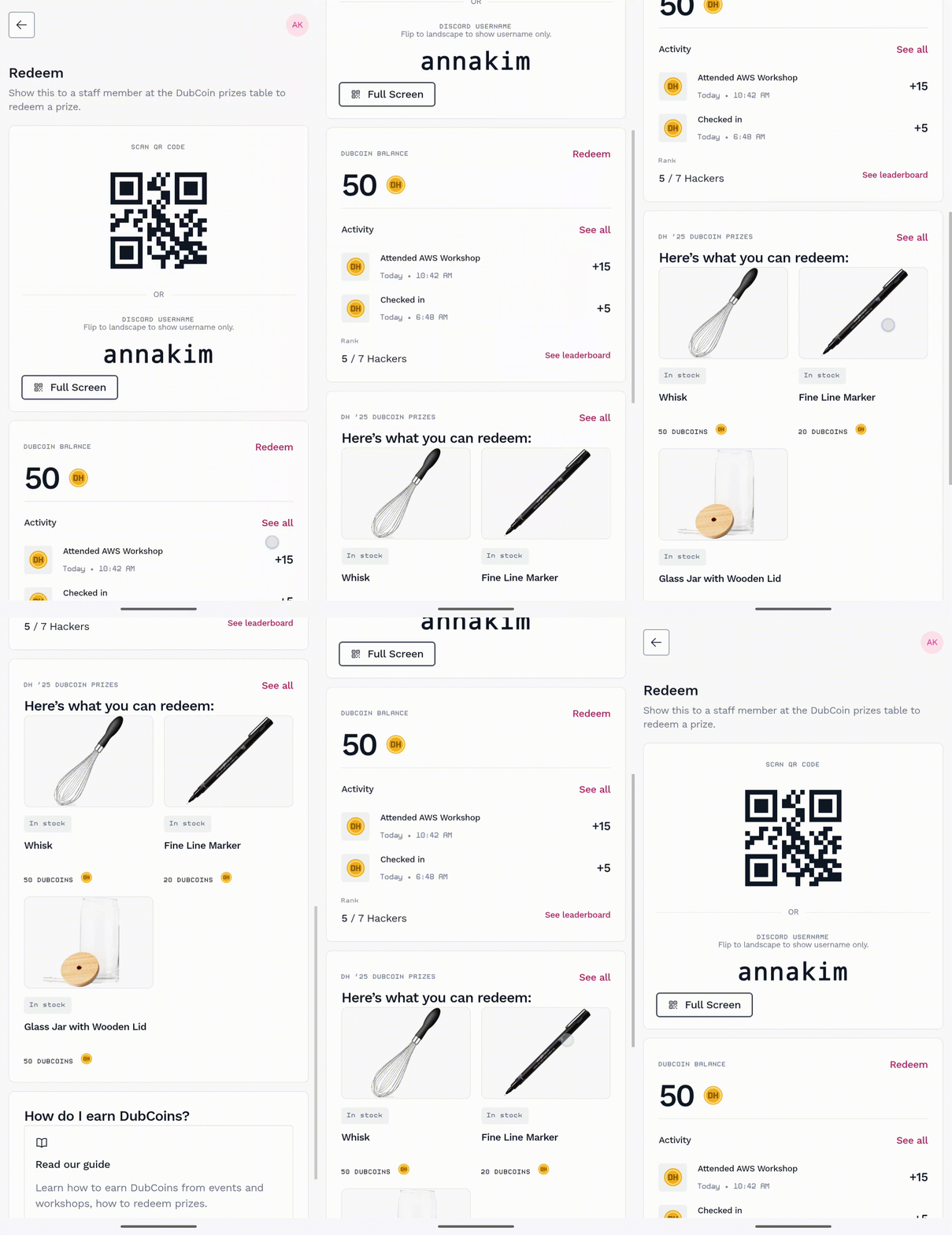
Hackers can show a QR code or a username.
The mobile redeem screen offers a full-screen QR code for fast scanning, and the required Discord username in large monospaced type as a backup. Staff can read it across the table when a scan isn’t practical.
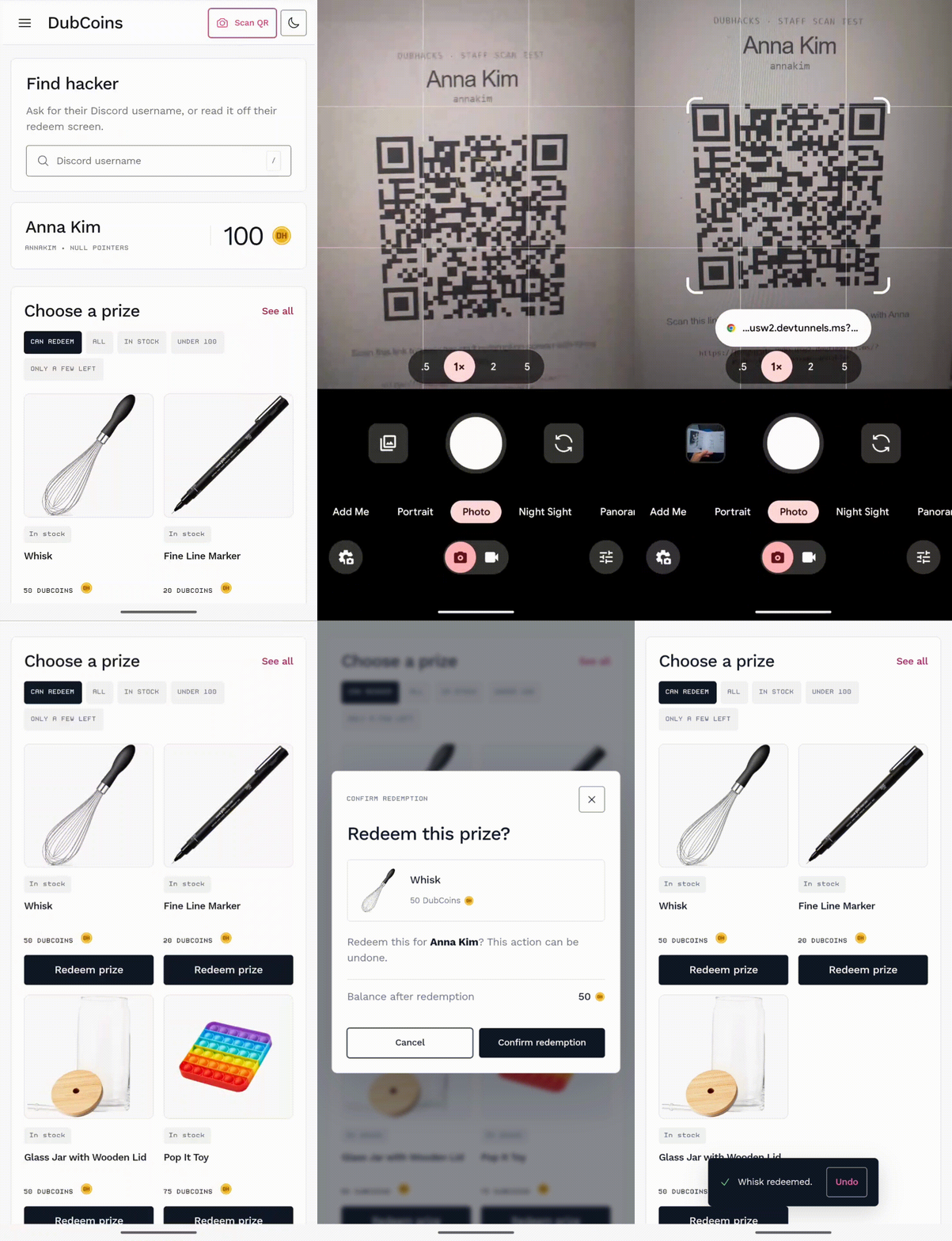
Staff can scan the code or type the name.
Scanning a hacker’s QR code pulls up their account in one step. When a scan isn’t possible, staff can type the username instead. Both paths lead to the same confirmation, so redemption works the same way either way.
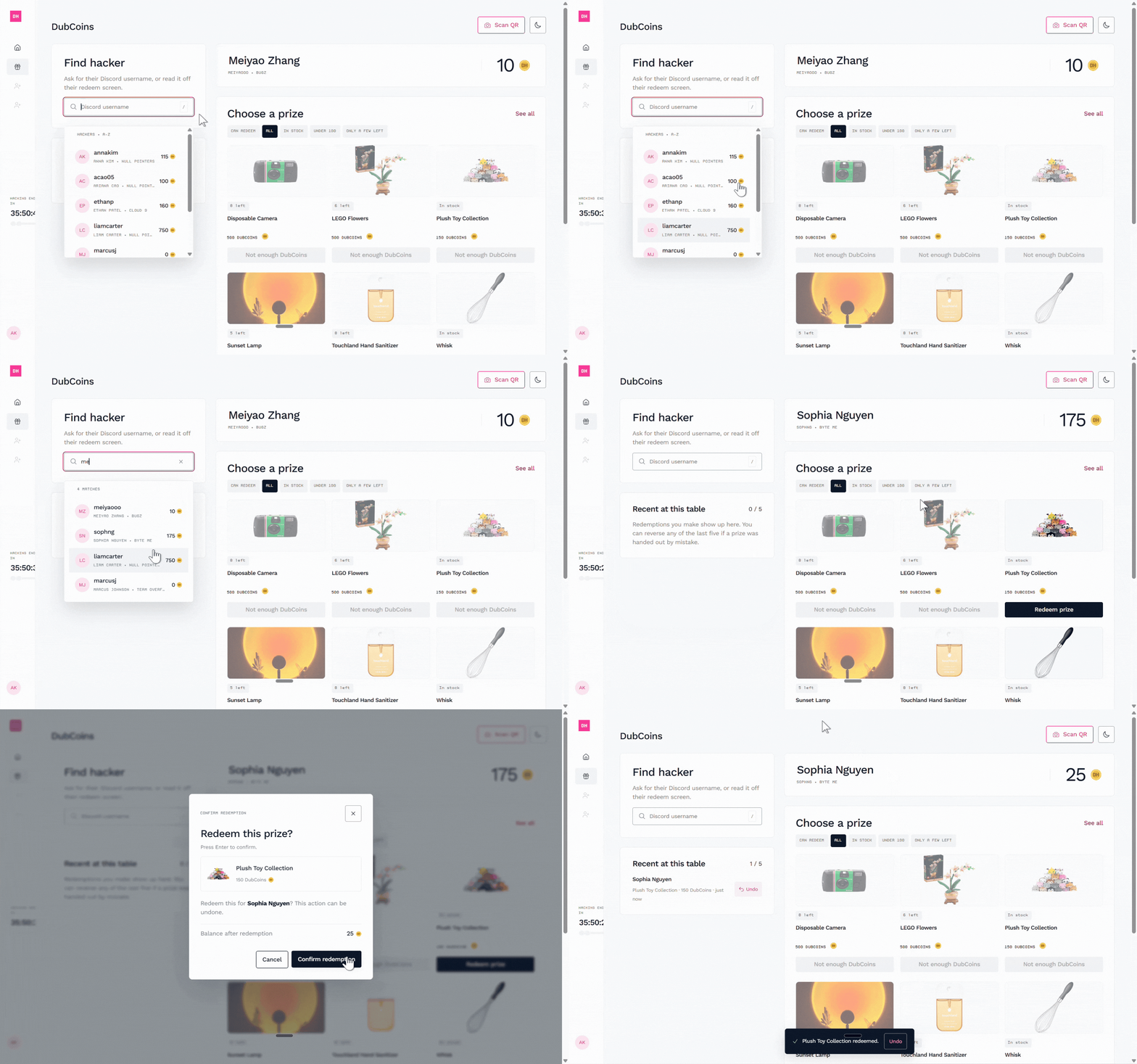
Search helps staff recognize the right person.
Fuzzy search results include username, real name, team, and balance, so a typo or half-remembered name still finds the right hacker. A slash shortcut opens search so staff can get to a person quickly.
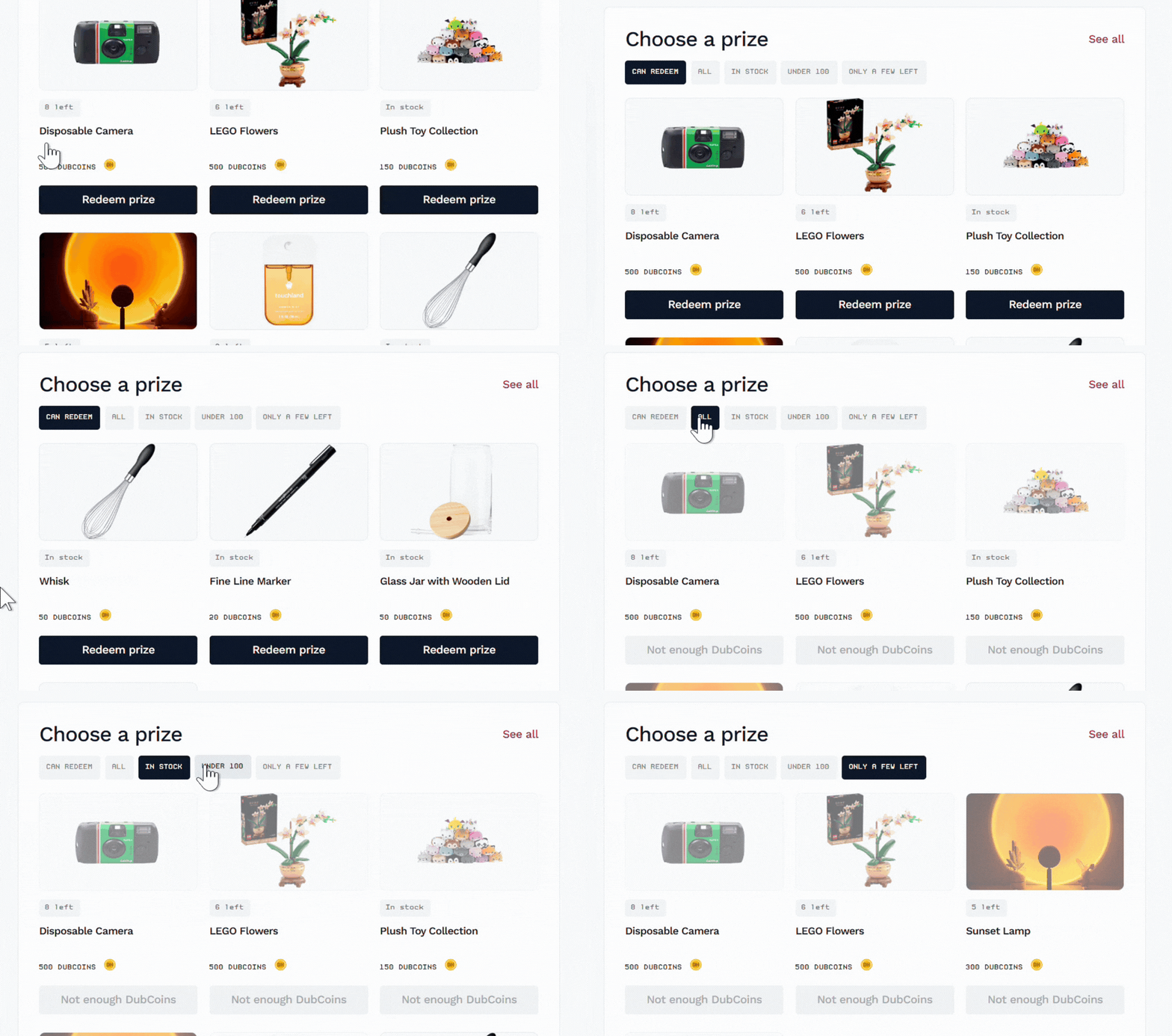
A cart makes the transaction clear.
Balance, cart total, and remaining balance stay visible together. Unaffordable and out-of-stock prizes are clearly marked, and filter chips narrow the list to what can actually be redeemed.
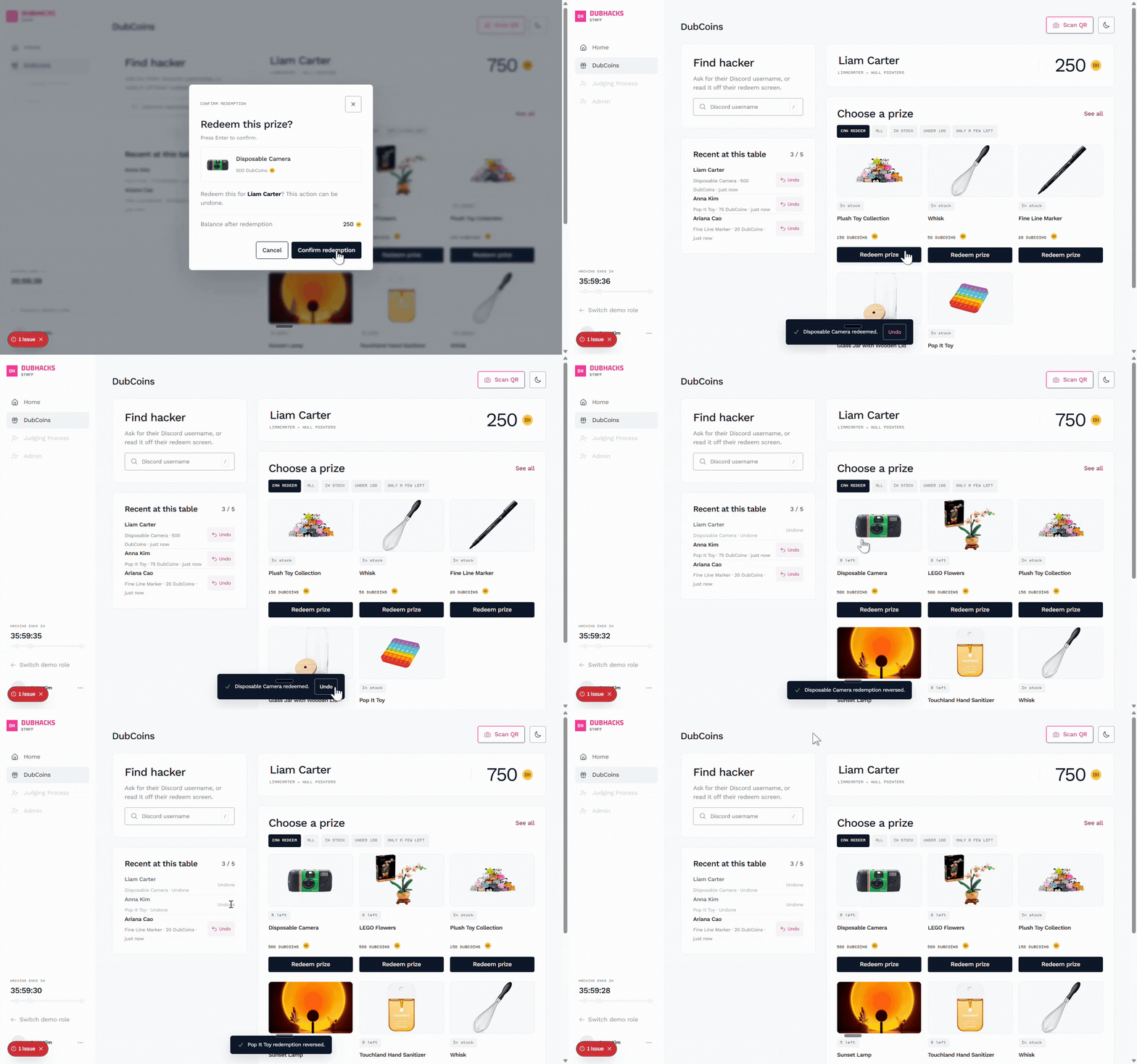
Mistakes can be undone at the table.
“Recent at this table” lists the latest transactions so staff can reverse a mistake without leaving the screen.
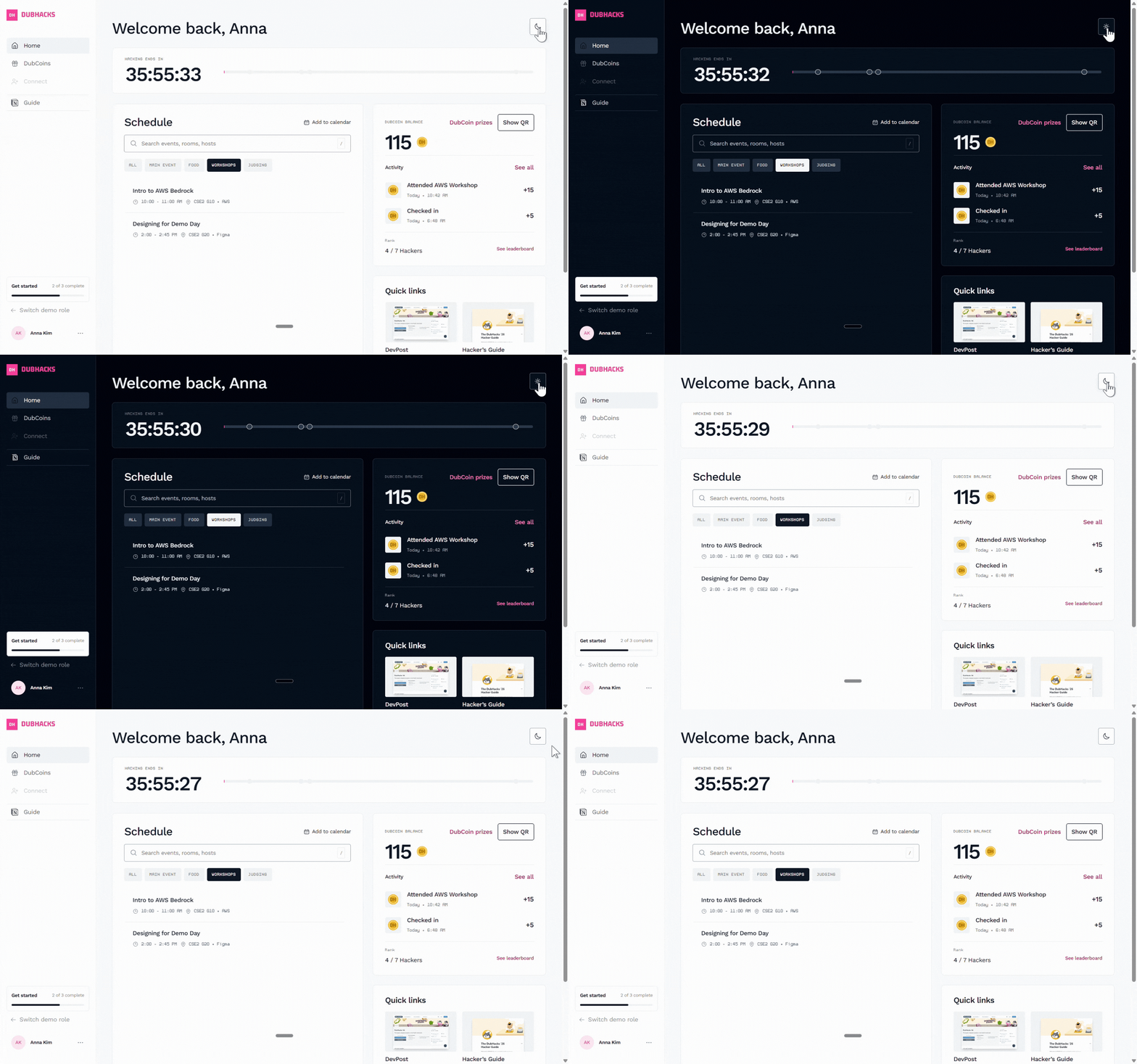
Dark mode for a long event.
The dashboard supports a dark theme built from the same system, so it stays readable for hackers and staff in a dim venue.
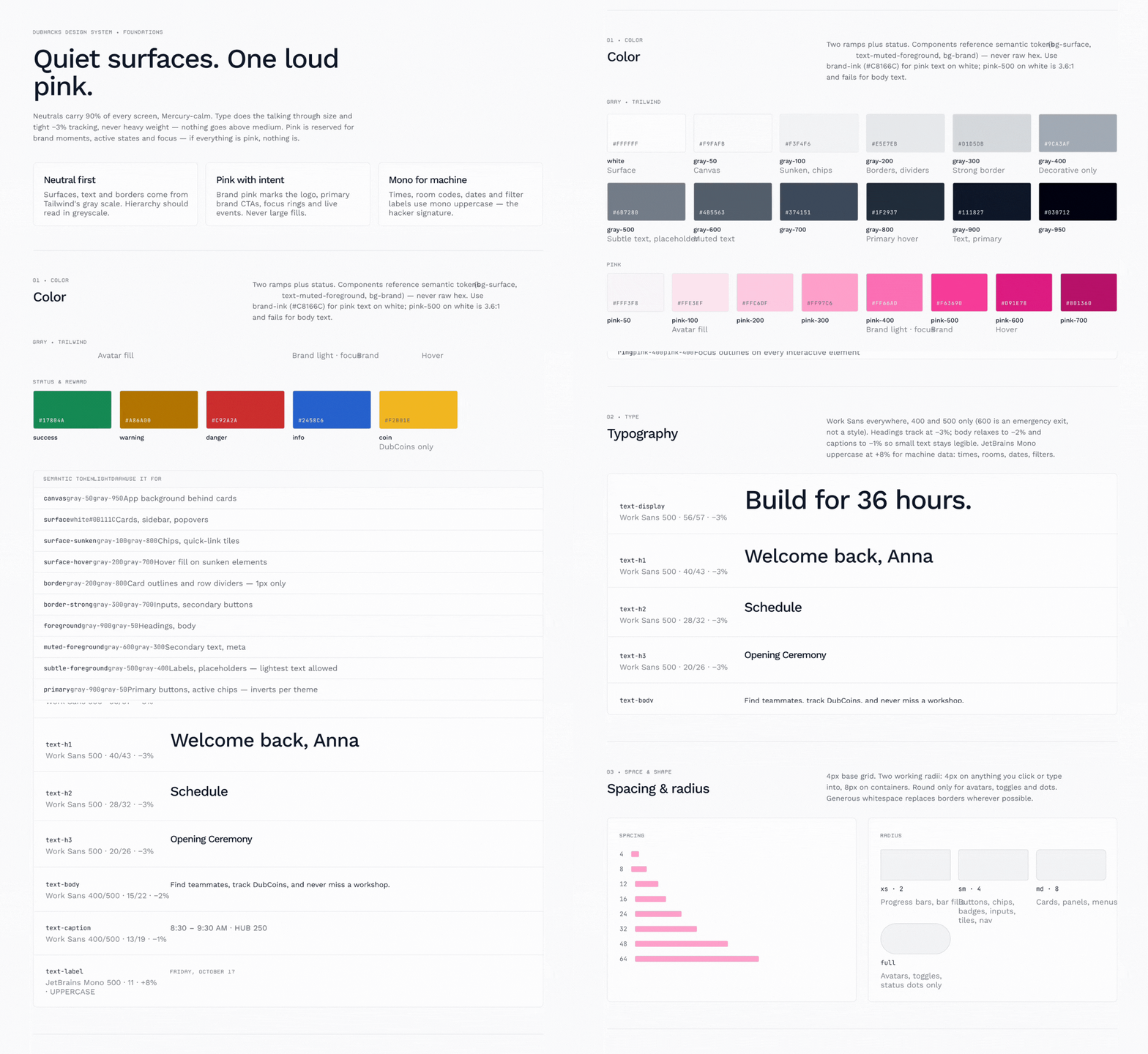
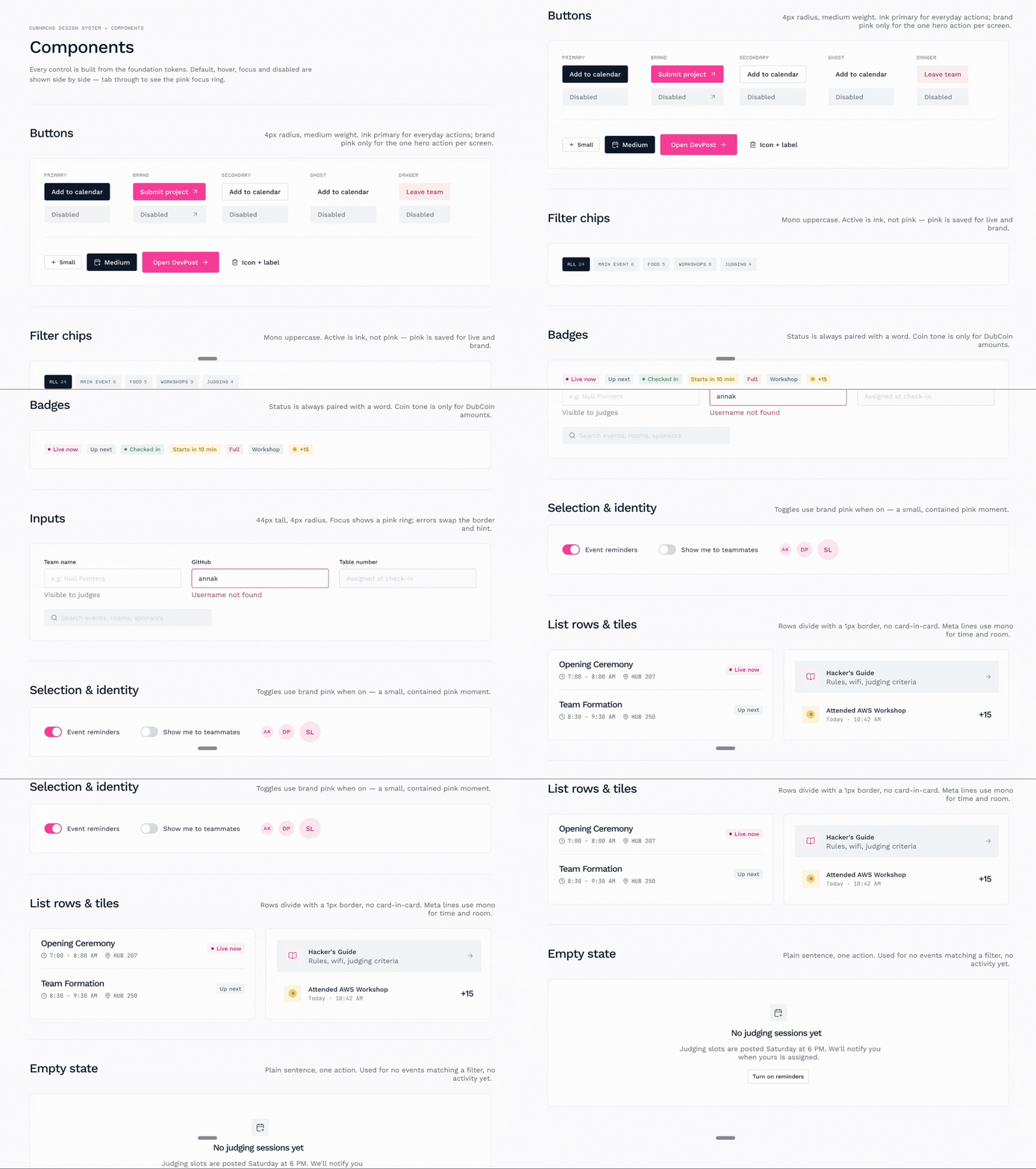
A design system built with AI, directed by me.
Figr helped generate a starting system. I directed its colors, neutral surfaces, Work Sans typography, spacing, and components. Everyday buttons use near-black because white on brand pink reaches only 3.6:1 contrast; pink is reserved for emphasis.
Build status
Version 2 is designed and entering user testing, but it has not shipped. The tech team is focused on the judging algorithm; the profile is planned for release next year.
Outcome
V1 shipped. V2 is designed, and not live yet.
The first profile served 1,030 hackers in 2025 and gave us evidence to shape the next iteration. Version 2 has a complete design direction and system ready for testing and a future build.
At the 2026 hackathon, I plan to test with available hackers and prize-table staff. Tasks include checking a balance, finding an affordable prize, showing a username, searching for a hacker, redeeming, and reversing a transaction. I’ll track time to item-in-hand, errors, and requests for help.
Reflection
What I’d tell my past self.
- Test in the real room. Lighting, lines, and crowded Wi-Fi mattered more than the QR flow’s neat prototype.
- A failed bet is still useful data. Watching QR slow people down gave us a clear reason to change course.
- People are a resource too. Staff made a simpler flow viable while the backend matured.
- Ask for the data. Usage files changed the direction of the redesign.
Next steps
Where it goes from here.
- 01
User-test the v2 hacker and staff flows during the event.
- 02
Design for 5–9 staff working at once, including stock holds, transaction locking, and clear conflict recovery.
- 03
Improve the mobile username view with a full-screen option and an auto-brightness request for tech.
- 04
Add UW NetID or email as backup search identifiers.
- 05
Work with tech on admin controls for prize visibility and overrides.